How Far Can We See? - Interesting Vision Facts

A question I frequently hear from my eleven-year-old granddaughter who lives with me is, "Grama how far can you see?" For her, the question is really all about "How far can she go within my line of vision, without an adult accompanying her?"
However, for me, that kind of question has been just one more daily reminder, that I have never been able to see as far, or as clearly as I long to.
Today, however, is a day of miracles. For today, I received prosthetic contact lenses. For the first time in my life (sixty years), I am able to see through both eyes, instead of just one. For the first time in my life, I have depth perception and 20/20 vision.
Goodbye on a daily basis to the trifocals that never fully corrected my vision. Today, I saw my eyebrows and eyelashes for the first time in years. Today, I could look across the room and read the crawler at the bottom of the news channel. Today, I see a whole lot that needs to be dusted around my house. This is huge and makes me immensely happy! (The only negative I saw, was an overnight appearance of some wrinkles on a familiar strangers face when I looked in the mirror).
In celebration of this life altering event -- I thought it might be fun to share what little I know about how far we can see.
Did you ever stand beside the ocean, and wonder just how far that horizon you were looking at -- really was from you?
Did you gaze from the shore and wonder how close that ship on the horizon truly was, and could you really swim to it?
Or maybe, you were out west, standing on a plateau or cliff looking far off to where the sun sets upon the horizon. Maybe, if you had a mind to, could you just walk off into the sunset, or would it be too far?
These are the kinds of things that daydreams are made of, and there is a fairly simple formula for determining how far mankind can see.

Just How Far Can Mankind See?
In the simplest terms -- When we say that our eyes see, all we really mean is that light has entered them and has affected them. When that happens, we see. It does not matter whether the light has been produced by a match that someone has held in front of our eye, or whether the light has come from a star so distant, that its light took ten thousand years to reach us.
In either case, if light enters our eyes in sufficient quantity to affect it, we see. The answer to our question, therefore, is that our eyes can see to any distance from which light can reach them. The question is, whether the light has that traveled billions and billions of miles, or only half an inch, which makes not the slightest difference to our eyes.
It is quite a distinct question, however, at what distance our eyes can distinguish the details of a particular thing. This depends on many variables, but it can be reckoned to some extent.
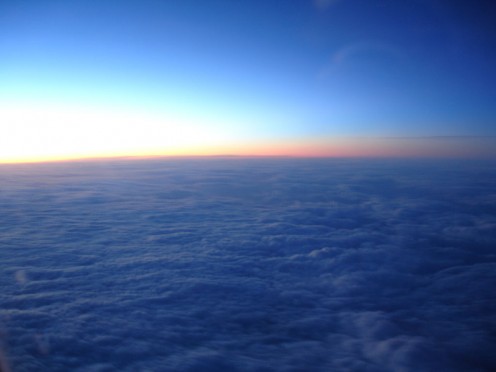
We know that if there were any building on the moon as large as some of our big sky scrapers, it could be recognized in our best telescopes. Standing at any given point, we can usually see what is called the horizon, from the Greek word horos, which means "boundary."

In this case, the horizon means the boundary between the earth and the sky. We understand, of course, that the line we see on the horizon -- is not really the boundary between earth and sky, but merely the boundary between them as they "appear" to our eyes.
As we stand by the seashore, the sky and the sea seem to meet. We can see a line which seems to be the end of the sea and the bottom of the sky. That is the horizon.
Similarly, if we stand on a plain or plateau of land we can, if there are no trees or houses in the way -- see where the end of the land "seems" to touch the bottom rim of the dome we call sky. That is also the horizon.
Its distance depends on how high our eyes are from the level of the sea, if we are looking across the sea, or from the level of the land across which we are look, or if we were looking over a plain.

Scientific Explanation
A person standing on the shore looks out on the sea, from a distance about five feet higher to six feet higher than the level of the sea (depending upon their height). Using the height of their eyes from seal level, roughly a person can see more than two and one half to three miles in front of them. Their horizon is just this distance away.
The eyes of the individual on the edge of a cliff, on the other hand, could be one hundred feet or more above sea-level, and in that instance, they can see about thirteen to fourteen miles off, for that is where their horizon is.
Then, if you were standing at the top of a lighthouse that is one hundred and fifty feet above sea-level, and if you looked out on the sea from this point, you would see about seventeen miles, and your horizon would also be the same.
The scientific explanation of all this would be that "range of vision is determined by the altitude of the observer." In simple language, this means that the higher up we are, the farther we can see. That is because our world is a globe.
Perhaps, we can understand better how this is if we stand in front of a row of houses forming a bulging crescent. Let us stand close to one of the houses and turn our heads first to the right, and then to the left. We cannot see much of the row of houses -- perhaps only a little bit of the house on each side of the one in front of which we are standing.
We step back into the middle of the street and look again. Now, we can see a good many more of the houses, but still not all, if the row is long. Then, we cross to the far side of the street, and many more will come within range.
To look for the horizon is much the same thing. The earth is round, and the farther we are above the ground along which we are looking, the farther we can see.
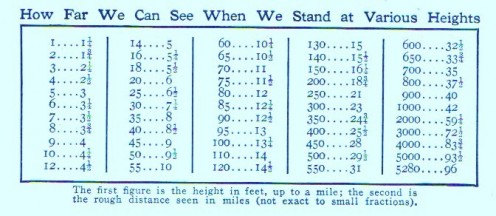
In the table I've made above, is shown how far anyone can see at various distances from the earth's surface. In the grand scheme of life it probably doesn't matter if we know how far off the horizon is, but it makes for pleasant debate to throw out that bit of simple knowledge -- especially with children.
They are always amazed to learn that at the one mile high -- we can see about ninety-six miles.
NOTE: The figures are approximate, as the table was drawn up for simplicity, and so it avoids small fractions.
If You'd Like To Know More!
- How to save your eyesight from heavy or prolonged c...
Very few people were lucky to come across some good advice on how to protect their eye health prior to use of computers. I was one such individual. Eyes are the most affected part of the body through heavy or... - I Have Duane Syndrome - A Rare Eye Condition
My left eye does not move to the left and is slightly off center. This is due to a rare eye condition that I was born with called Duane Syndrome. My entire life I have had to compensate for my eye... - Is It Possible To Improve Vision Without Surgery Or ...
3 Beliefs of Poor Vision Many people believe that their poor vision is caused by: 1) Heredity i.e due to genetics that are unchangeable 2) Age i.e. vision deteriorates with age 3) Eyeballs that are just... - Vision without Glasses: a safer alternative to laser...
You'd love to throw away your glasses, but Lasik (laser eye surgery) scares you? At last, there's an alternative - orthokeratology! OrthoK involves the wearing of special lenses at night, which gently correct... - You Have Computer Vision Syndrome!
Today, millions of people all over the world are affected by Computer Vision Syndrome or CVS without them realizing it. I am a full time work at home person who spends more than 10 hours a day on my PC....